 Business Intelligence
 Customer Relationship Management
 Document Management
 Finance Management
 Governance, Risk & Compliance
 Human Resources
 Planning and Scheduling
 Product Data Management
 Production Management
 Project Management
 Retail Management
 Sales Management
 Service Management
 Small and Midsize Enterprises
 Supplier Relationship Management
 Supply Chain Management
 Warehouse Management
 e-Commerce
Discover how ERP-integrated warehouse management improves inventory visibility, stock accuracy, traceability, productivity and order fulfilment.
How Can Warehouse Management Systems Boost Your Business?
Discover how warehouse management systems improve inventory visibility, stock accuracy, traceability, productivity and order fulfilment.
Warehouse management is a crucial part of any manufacturing or distribution business. Whether you are storing raw materials, components, work in progress or finished products, inefficient warehouse processes can increase costs, delay production and affect customer service.
However, the warehouse does not operate in isolation. Every receipt, stock movement, material issue and customer shipment can affect purchasing, production, sales, finance and the wider supply chain.
A warehouse management system provides the tools needed to control these activities. When warehouse management is integrated with enterprise resource planning software, it can connect inventory data with processes across the entire business.
This creates a shared, real-time view of stock and helps teams coordinate purchasing, production planning, order fulfilment, traceability and financial control.
Take warehouse management beyond the desktop

What is a Warehouse Management System?
A warehouse management system, commonly known as a WMS, is software used to control and optimise the movement, storage and availability of inventory.
Warehouse management software can support processes including:
- Goods receiving and inspection
- Put-away and stock location management
- Barcode scanning and inventory tracking
- Stock transfers and replenishment
- Material issues to production
- Picking, packing and shipping
- Batch and serial number traceability
- Stocktaking and cycle counting
- Returns and quality control
- Warehouse reporting and performance analysis
A standalone WMS primarily focuses on warehouse execution. When warehouse management functionality is integrated with ERP, each warehouse transaction can also inform related business processes.
For example:
- Receiving materials updates inventory and purchasing records.
- Issuing components updates stock and manufacturing information.
- Picking a sales order updates fulfilment and availability data.
- Shipping an order provides information for sales, customer service and finance.
- Recording batches or serial numbers creates an end-to-end traceability record.
This integration removes barriers between the warehouse and other departments, creating a single, consistent source of operational information.
What Are the Benefits of a Warehouse Management System?
A warehouse management system can improve stock accuracy, reduce manual administration, accelerate order fulfilment and provide real-time inventory visibility.
When connected with ERP, warehouse management software can also help manufacturers and distributors understand how inventory decisions affect production requirements, customer demand, purchasing activity and financial performance.
Here are the principal benefits.
1. Maintain Optimum Stock Levels
Managing inventory is a balancing act. Holding too much stock ties up working capital and consumes valuable warehouse space, while holding too little can cause production delays, stockouts and missed customer delivery dates.
Warehouse management software provides real-time information about stock quantities, availability and locations. Teams can identify low-stock items, excess inventory and slow-moving materials before they become larger problems.
When warehouse data is connected with purchasing, sales and production information, the business can plan replenishment around actual and anticipated demand rather than relying on isolated warehouse records.
2. Improve Inventory Accuracy and Visibility
Spreadsheets, paper records and disconnected systems can create a gap between what is physically in the warehouse and what the business believes is available.
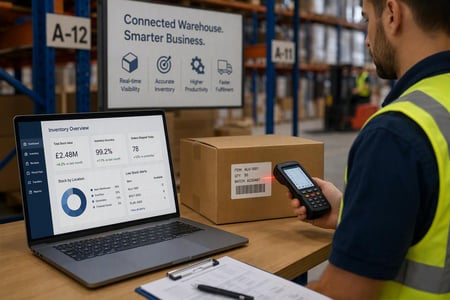
Barcode scanning and mobile data capture allow stock movements to be recorded as work is completed. This can reduce duplicate data entry, transcription errors and delays in updating inventory records.
Accurate, real-time inventory data gives purchasing, production, sales and customer service teams access to the same information. Employees can answer stock questions more confidently and make decisions using a consistent source of data.
3. Connect the Warehouse with Production
For manufacturers, warehouse performance has a direct effect on production.
Materials must be available in the correct quantity, at the correct location and at the right time. If components cannot be found or stock records are inaccurate, production schedules can be disrupted and employees may lose time waiting for materials.
Integrated warehouse management connects inventory with bills of materials, manufacturing orders, material requirements planning and production activity.
This helps the business understand:
- Which materials are required for upcoming production
- Whether the required stock is available
- Where components are stored
- Which materials have already been issued
- What work in progress is being held
- How stock availability could affect production schedules
Connecting warehouse and manufacturing information helps teams identify material shortages earlier and maintain a smoother flow of work.
4. Reduce Warehouse and Inventory Costs
Poor warehouse visibility can lead to unnecessary purchasing, avoidable stock write-offs, inefficient use of space and excessive time spent searching for materials.
Warehouse reporting can highlight picking delays, recurring stock discrepancies, excess inventory, slow-moving items and other operational bottlenecks.
Managers can use this information to focus improvement activity where it will have the greatest effect on warehouse productivity, working capital and profitability.
Integration with ERP also provides a clearer picture of how inventory decisions affect purchasing costs, production performance, order margins and cash flow.
5. Increase Employee Productivity
Warehouse employees can work more efficiently when they have clear instructions, accurate stock locations and access to current information.
Mobile warehouse management tools can support users through receiving, put-away, stock checks, picking, packing and dispatch. Barcode scanning can confirm that the correct item, quantity and location are being used at each stage.
Practical automation can reduce manual keying, remove paper-based handovers and make information available at the point of work.
This allows employees to spend less time searching for stock, checking paperwork or correcting data and more time completing productive warehouse activities.
6. Accelerate Picking, Packing and Order Fulfilment
Fast and reliable order fulfilment depends on accurate inventory information and consistent warehouse workflows.
A warehouse management system can help teams prioritise orders, identify available stock, locate items and confirm each picking and packing step.
When warehouse management is connected with ERP, information about an order can be made available to other relevant departments as soon as its status changes. Sales and customer service teams can check progress without needing to request a separate update from the warehouse.
Improved order accuracy can reduce returns, rework and customer complaints while helping the business meet its delivery commitments.
7. Strengthen Traceability and Quality Control
Manufacturers operating in regulated or quality-sensitive industries may need to know where materials originated, how they were used and where finished products were delivered.
Warehouse management software can maintain a digital history of stock movements using batch numbers, serial numbers and transaction records.
When this information is connected with purchasing, production and sales data, the business can create end-to-end traceability from goods receipt through manufacturing to customer delivery.
This can support:
- Quality investigations
- Internal and external audits
- Product recalls
- Regulatory compliance
- Supplier performance reviews
- Batch and serial number tracking
- Waste and cost analysis
Integrated traceability provides more complete information than warehouse records held separately from production and customer data.
8. Introduce New Products More Smoothly
Launching a new product creates new material requirements, storage needs and production dependencies.
If one component is unavailable, incorrectly recorded or stored in the wrong location, the production schedule can be disrupted.
An integrated ERP and warehouse management system connects product data, bills of materials, purchasing, inventory and production planning. This helps teams confirm that the required materials are available before production begins and understand when additional stock needs to be ordered.
Businesses can introduce new product lines with greater control, without relying on fragmented records or last-minute manual checks.
9. Support Automation and Business Growth
Processes that work for a small warehouse may become difficult to manage as order volumes, product ranges, locations and customer expectations increase.
Warehouse management software establishes consistent processes that can be applied across more users, products and warehouse locations. Managers can retain visibility as the operation grows without creating additional spreadsheets or layers of manual administration.
Accurate and connected warehouse data also provides a foundation for mobile applications, barcode scanning, automated equipment and data-led decision-making.
The objective is not automation for its own sake. It is to reduce repetitive work, give people clearer information and improve the speed and consistency of operational decisions.
Bringing Your Warehouse Operations Together
Effective warehouse management is not simply about knowing how much stock is available or where an item is located. It is about understanding how every stock movement affects production, purchasing, customer orders, costs and overall business performance.
When warehouse management is integrated with ERP, manufacturers and distributors gain one connected flow of information across their operations.
This can reduce inventory costs, improve warehouse productivity, strengthen traceability and help teams respond more confidently to changing production and customer requirements.
By replacing disconnected systems and manual records with accurate, real-time information, businesses can create warehouse processes that support both day-to-day efficiency and long-term growth.
See Connected Warehouse Management in Action
Discover how mobile warehouse workflows can simplify data capture and provide access to real-time ERP information wherever operational activity takes place.

Frequently Asked Questions About Warehouse Management Systems
Is a warehouse management system only suitable for large businesses?
No. Small and medium-sized manufacturers and distributors can also benefit from warehouse management software.
It can be particularly valuable when increasing product ranges, order volumes or warehouse locations have made spreadsheets and paper-based processes difficult to control.
How does a warehouse management system complement ERP?
A warehouse management system controls the movement, storage and availability of inventory, while ERP connects processes across purchasing, manufacturing, sales, finance and the wider supply chain.
When the two are integrated, warehouse transactions can automatically inform related business processes. This reduces duplicate data entry, improves visibility and gives teams a consistent source of operational information.
How does warehouse management improve inventory accuracy?
Warehouse management software can improve inventory accuracy by recording goods receipts, stock movements, material issues, picks and shipments as they happen.
Barcode scanning and mobile data capture can reduce manual entry and help confirm that the correct item, quantity and location are being used.
Can warehouse management software work on mobile devices?
Yes. Mobile warehouse management applications can give employees access to live inventory information and support barcode scanning, stock checks, receiving, put-away, picking, packing and other transactions at the point of work.
When connected with ERP, the information recorded on a mobile device can update the central business system.



.png?width=120&height=120&name=MicrosoftTeams-image%20(4).png)