 Business Intelligence
 Customer Relationship Management
 Document Management
 Finance Management
 Governance, Risk & Compliance
 Human Resources
 Planning and Scheduling
 Product Data Management
 Production Management
 Project Management
 Retail Management
 Sales Management
 Service Management
 Small and Midsize Enterprises
 Supplier Relationship Management
 Supply Chain Management
 Warehouse Management
 e-Commerce
Still relying on spreadsheets this summer? Here is where control starts to slip.
Summer can be a challenging time for many manufacturing businesses.
With team members taking annual leave, departments managing reduced cover, and workloads still needing to move forward, everyday processes can come under pressure very quickly.
In quieter periods, workarounds might feel manageable. A spreadsheet here, a manual update there, a quick message to check a status. But when the right person is away or teams are stretched, those small gaps can quickly become bigger problems.
Here are five common summer bottlenecks that often expose weak processes.
1. Holiday absence creates approval delays
When key people are out of the business, approvals can slow down.
Purchase orders, sales orders, stock decisions, production changes, or financial sign-offs may all rely on specific individuals. If there is no clear process in place, work can stall while teams wait for someone to return or search for the right information.
This can be especially frustrating when customers, suppliers, or internal teams are expecting quick answers.
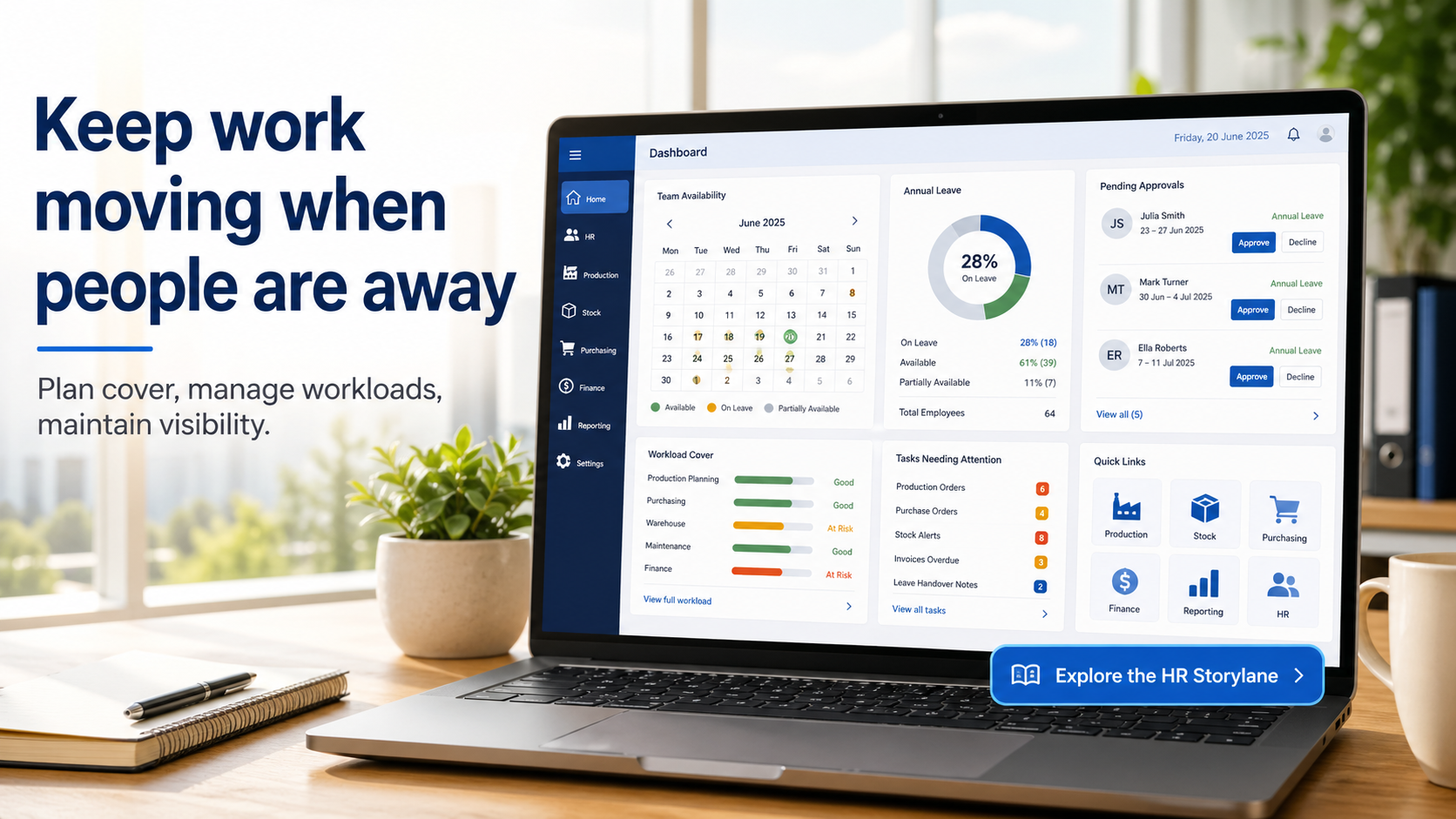
A strong system should make it clear what needs approval, who can action it, and where things currently stand.
2. Spreadsheets become harder to manage
Spreadsheets can be useful, but they often rely heavily on the people who created them.
During summer, this can become a real issue. If one person usually updates the spreadsheet, understands the formulas, or knows which version is correct, their absence can leave the rest of the team exposed.
Version control can slip. Updates may be missed. Information can become outdated without anyone realising.
When important business processes depend on disconnected spreadsheets, control can quickly become difficult to maintain.
3. Data has to be entered more than once
Duplicate data entry is never ideal, but it becomes more noticeable when teams have less capacity.
If the same information has to be entered into multiple systems, spreadsheets, or documents, it creates extra work for already stretched teams. It also increases the chance of errors.
A customer order may need to be added in one place, checked in another, then manually updated elsewhere. Each step takes time. Each manual entry creates risk.
When departments are busy or short-staffed, duplication can slow everything down.
4. Systems do not speak to each other
Disconnected systems can create major visibility issues.
Sales may have one view of customer demand. Production may be working from another set of information. Purchasing may not have a clear picture of what is needed or when.
When information sits in silos, teams are forced to chase updates manually. This can lead to delays, confusion, or decisions being made without the full picture.
During summer, when communication can already be harder due to annual leave, disconnected systems can make day-to-day control even more difficult.
5. Reporting takes too long
Leaders need quick answers, especially when teams are stretched.
Which orders are at risk? What stock needs attention? Where are delays starting to build? Are customers being impacted?
If reporting depends on manually pulling data from different places, it can take too long to get the answers needed.
By the time the report is ready, the situation may have already changed.
Reliable reporting should give decision-makers a clear view of what is happening across the business, without relying on time-consuming manual work.
Is summer exposing gaps in your processes?
Summer often highlights issues that may already exist in the business.
Approval delays, spreadsheet confusion, duplicate entry, disconnected systems, and slow reporting are not just seasonal problems. They are signs that processes may not be as controlled as they need to be.
For manufacturers, having one connected Enterprise Resource Planning (ERP) system can help teams work from the same information, reduce manual admin, and maintain visibility across key areas of the business.
If your processes feel harder to manage when people are away, it may be time to look at where better control could make a difference.
ERP helps SME manufacturers gain greater visibility across their operations, from sales to purchasing through to production, stock, finance, and reporting. Making Summer a breeze.
Contact us today to find out how WinMan can benefit you.





.png?width=120&height=120&name=MicrosoftTeams-image%20(4).png)