 Business Intelligence
 Customer Relationship Management
 Document Management
 Finance Management
 Governance, Risk & Compliance
 Human Resources
 Planning and Scheduling
 Product Data Management
 Production Management
 Project Management
 Retail Management
 Sales Management
 Service Management
 Small and Midsize Enterprises
 Supplier Relationship Management
 Supply Chain Management
 Warehouse Management
 e-Commerce
Rising costs, tighter margins, and Government policy changes on the way. Here's how real time business intelligence helps manufacturers make faster, smarter cost decisions, without cutting into production or quality.
Cost pressure isn't going away, but panic decisions rarely pay off
For most SME manufacturers, the last few years haven't been about one single spike or one single crisis. Energy prices, raw material costs, wages and freight have all moved at different times, for different reasons, and rarely all at once. The result is a business environment where costs feel permanently unpredictable, rather than temporarily difficult.
The instinct in that kind of environment is often to react quickly: freeze spending, delay a hire, cut a supplier, renegotiate a contract. Some of that is sensible. But the manufacturers who come out ahead over a full year aren't the ones who react fastest. They're the ones who can actually see where their money is going, in enough detail to make a good decision rather than a rushed one.
That's the shift worth making now. Not another round of generic cost cutting, but a proper look at visibility.
Short on time? A single, connected ERP gives manufacturers full visibility of costs, margins and production data in one place, so decisions are based on real numbers rather than guesswork.

Where manufacturers actually lose money, and don't always see it
Ask most production managers where cost creeps in, and they'll usually point to the obvious things: material prices, energy use, wastage. All fair. But a lot of the real cost sits somewhere less visible:
- Overhead absorption that's out of date, so product costings look fine on paper but aren't tracking reality on the shop floor.
- Machine and labour time that isn't captured accurately, making it hard to know which jobs are genuinely profitable.
- Stock sitting in the wrong place, tying up cash and space without anyone noticing until a stocktake.
- Manual reporting, whereby the time a spreadsheet is pulled together, the numbers are already a week or two out of date.
- What is this product actually costing us to make right now, including overhead?
- Which jobs, customers or product lines are genuinely profitable, and which are barely breaking even?
- Where is stock and cash tied up, and is it where it needs to be?
- Are we on track against this quarter's plan, or drifting without realising it?
- Real time dashboards for production, stock and financial performance, visible to the people making decisions, not just finance at month end.
- KPI and OEE monitoring, so machine and labour performance is tracked as it happens, not reconstructed after the fact.
- Product and job costing that reflects reality, including overhead absorption, so pricing and quoting decisions are based on true margin.
- Predictive and trend reporting, so a cost problem is spotted early enough to act on it, rather than explained after the quarter has already closed.
None of this shows up as a single alarming cost. It shows up as margin that's quietly thinner than it should be, spread across dozens of small decisions a week.
What “visibility” actually means for a manufacturing business
Visibility isn't a dashboard for its own sake. It means being able to answer, on demand and without waiting for someone to build a report:
When finance, production and stock data all sit in one system, those questions have real-time answers. When they sit in separate spreadsheets, Excel exports and disconnected software, the honest answer is usually “we'd need to check.”
Business intelligence and reporting: turning data into decisions
This is where business intelligence and reporting earns its place as more than a nice-to-have. Done well, it means:
None of this replaces good judgement. It just means judgement is based on what's actually happening in the business, rather than what happened a few weeks ago.
Why this matters even more for electronics manufacturers
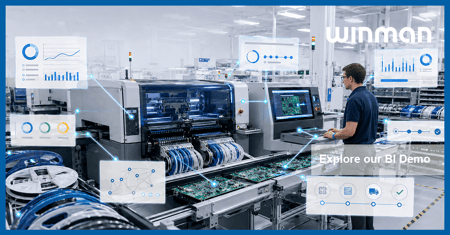
Electronics manufacturing tends to combine several cost pressures at once: high component costs, complex multi-level bills of materials, tight tolerances on quality, and often a mix of make-to-order and make-to-stock work running side by side. Small errors in costing or overhead absorption compound quickly across hundreds of components and variants.
For electronics manufacturers specifically, the businesses managing costs best tend to be the ones with clear, real time visibility of component costs, work in progress and margin by product, not just at year end, but as every job moves through the shop floor.
Planning around policy changes, without waiting for them
Government announcements on tax, business rates and other cost measures are a regular fixture of the calendar. Speculation about what's coming tends to build in the run up. It's tempting to hold off on any planning until the announcement lands.
In practice, the businesses in the strongest position once the announcement lands won't be the ones who waited to see what changed. They'll be the ones who already had clear visibility of their costs, margins and cash position. They can simply plug whatever the announcement brings into a plan they can already see clearly. Good visibility doesn't predict what's coming. It just means you're ready for whatever it says.
Electronics manufacturers face this pressure more than most, since the cost base is already complex before any external change lands. Electronics manufacturing tends to combine several cost pressures at once: high component costs, complex multi-level bills of materials, tight tolerances on quality, and often a mix of make-to-order and make-to-stock work running side by side. Small errors in costing or overhead absorption compound quickly across hundreds of components and variants.
For electronics manufacturers specifically, the businesses managing costs best tend to be the ones with clear, real time visibility of component costs, work in progress and margin by product, not just at year end, but as every job moves through the shop floor. It's worth seeing how this looks in practice. Our video case study with Kasdon Electronics looks at exactly this challenge, and how better visibility changed the way they manage costs day to day.
Smarter manufacturing in action
Cost control isn't about cutting harder. It's about seeing clearly enough to cut the right things, or not cut at all, and to make that call with confidence rather than guesswork.
Ready to see what this looks like for your business? Contact us today for a quick chat about your current processes.

FAQs
What is the best way to reduce manufacturing costs without cutting quality?
Focus on visibility before cost cutting. Understanding true product costs, overhead absorption and machine or labour performance in real time helps identify where money is genuinely being lost, so decisions target the right areas rather than making across the board cuts that risk quality or output.
How does an ERP help with cost visibility?
An all-in-one ERP brings finance, production, stock and reporting into a single system. This means costing, margin and performance data update in real time, rather than being pieced together from separate spreadsheets, giving an accurate, current view of where money is being spent.
What is business intelligence in manufacturing?
Business intelligence in manufacturing refers to real time dashboards, KPI tracking and reporting tools that turn production, stock and financial data into clear, actionable insight, such as OEE, product margin and cost trends, without needing separate analysis tools.
Should manufacturers wait for a Budget announcement before reviewing costs?
No. Reviewing cost visibility now means a business can respond quickly to whatever a Budget or policy change introduces, rather than starting the review from scratch afterwards. Good cost visibility is useful regardless of what any single announcement contains.
What ERP features help electronics manufacturers control costs?
Multi-level bill of materials management, accurate overhead absorption, real time product costing, and production scheduling are particularly valuable for electronics manufacturers, given the complexity of components, variants and tight production tolerances involved.
Is an all in one ERP better than separate systems for cost control?
A single, connected platform avoids the delays and inconsistencies that come from combining data across several disconnected tools. When finance, production and stock all sit in one system, cost and margin reporting reflects the business as it stands today, not a version reconstructed after the event.




.png?width=120&height=120&name=MicrosoftTeams-image%20(4).png)